
How to Interpret Answer Keys Effectively
- Jan 19
- 4 min read
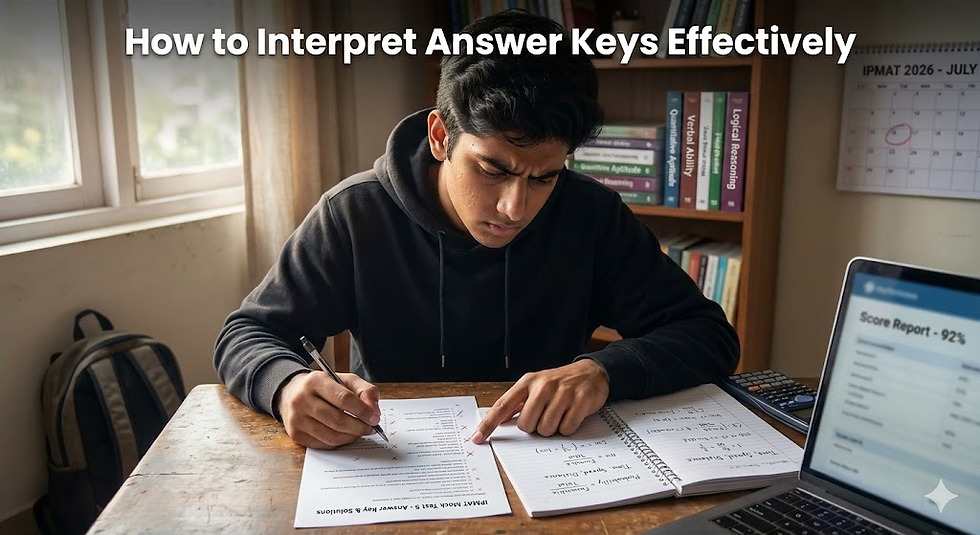
Interpreting an answer key is one of the most underestimated yet decisive steps in competitive exam preparation. Many aspirants glance at their score, feel satisfied or disappointed, and move on. However, those who truly understand how to analyze answer key effectively convert every test into a powerful learning opportunity—especially for exams like IPMAT, where precision, accuracy, and strategy determine success.
This guide will walk you through a structured, expert-level approach to answer key analysis so that every mock test or practice paper actively improves your rank potential.
Why Answer Key Analysis Matters More Than the Score
Your raw score is only a snapshot. Answer key analysis is the full diagnostic report.
When you analyze an answer key effectively, you uncover:
Conceptual gaps that are repeatedly costing marks
Time-management issues hidden behind incorrect attempts
Guesswork patterns that increase negative marking
Strengths that should be leveraged strategically
Aspirants who skip this step often stagnate, while those who master answer key analysis steadily improve—even with fewer mock tests.
Understanding the Structure of an Answer Key
Before diving into analysis, it is essential to understand what an answer key represents.
An answer key typically includes:
Correct options for each question
Section-wise distribution
Sometimes, official explanations or solutions
For IPMAT aspirants, the answer key becomes even more useful when paired with the response sheet and marking scheme.
Step-by-Step Guide on How to Analyze Answer Key Effectively
Start With Question-Level Evaluation
Begin by reviewing each question individually, not section-wise scores. Categorize every question into one of the following:
Correct with confidence
Correct by guess
Incorrect due to concept
Incorrect due to calculation or reading error
Left unattempted
This classification is critical to analyze answer key effectively rather than emotionally.
Identify the Root Cause of Every Mistake
Merely knowing that an answer is wrong is useless unless you know why.
For each incorrect question, ask:
Was the concept unclear?
Was the formula forgotten or misapplied?
Was time pressure the reason?
Did you misread the question?
This level of introspection transforms the answer key into a personalized improvement roadmap.
Calculate Your Score the Right Way
Many aspirants miscalculate scores, leading to incorrect performance assumptions.
While analyzing the answer key:
Apply the correct marking scheme
Account for negative marking accurately
Separate sectional performance
This is also the best stage to simulate real exam conditions using practice resources like an ipmat free mock test, where detailed answer keys allow structured evaluation.
Section-Wise Answer Key Interpretation Strategy
Quantitative Aptitude (SA & MCQ)
For Quant, your focus should be:
Accuracy versus speed
Repeated error patterns in arithmetic or algebra
Time spent per correct question
If a question took too long but was correct, it still needs attention. Efficiency matters as much as correctness.
Verbal Ability
In Verbal sections, answer key analysis helps identify:
Weak grammar concepts
RC inference mistakes
Vocabulary-based confusion
Track whether errors stem from lack of knowledge or interpretation errors. This distinction guides future preparation.
Creating an Error Log From Answer Key Analysis
One of the most effective yet ignored practices is maintaining an error log.
Your error log should include:
Question type
Mistake reason
Correct concept or rule
Preventive strategy
Aspirants who consistently maintain an error log from answer key analysis show faster improvement than those who simply attempt more questions.
Using Answer Key Analysis to Improve Mock Test Strategy
Answer keys are not just for learning concepts—they refine strategy.
Through consistent analysis, you can determine:
Ideal attempt count
Sections to attempt first
Questions to skip confidently
When combined with structured guidance from online ipmat coaching, answer key insights translate directly into smarter test-taking decisions.
Common Mistakes Students Make While Analyzing Answer Keys
Mistake | Why It Hurts Performance |
Checking only the score | No insight into improvement areas |
Ignoring correct guesses | Reinforces risky behavior |
Skipping unattempted questions | Misses easy scoring opportunities |
No written analysis | Learning fades quickly |
Emotional reaction | Clouds objective assessment |
Avoiding these mistakes is essential to analyze answer key effectively and consistently.
How Often Should You Analyze Answer Keys?
Ideally:
Every mock test: Same day analysis
Sectional tests: Within 24 hours
Previous papers: Deep analysis over multiple sessions
Quality analysis matters more than frequency. One thoroughly analyzed test is more valuable than three superficial ones.
How Answer Key Analysis Improves Final IPMAT Performance
Over time, effective answer key analysis:
Reduces negative marking
Improves accuracy under pressure
Builds question selection intuition
Strengthens weak concepts permanently
This cumulative advantage often becomes the difference between clearing the cutoff and missing it narrowly.
Frequently Asked Questions
Is answer key analysis more important than attempting mocks?
Both are important, but without proper analysis, mock tests lose most of their value.
Should I analyze even very bad mock test performances?
Yes. Poor performances often provide the most learning opportunities.
How long should answer key analysis take?
Ideally, 1.5 to 2 times the duration of the test itself.
Can beginners benefit from answer key analysis?
Absolutely. Early adoption builds disciplined preparation habits.
Conclusion
Understanding how to analyze answer key effectively is a skill that separates average aspirants from consistent high performers. Scores fluctuate, but insights gained from answer key analysis compound over time. When done methodically, every answer key becomes a mentor—highlighting weaknesses, reinforcing strengths, and sharpening strategy.
If you treat answer key analysis as an integral part of preparation rather than a post-test formality, improvement is not just possible—it is inevitable.


Comments